


The artificial intelligence buildout is putting extraordinary pressure on data center cooling. AI-driven workloads are pushing infrastructure to its limits, and operators investing billions in cooling systems may find a well-documented physics problem quietly undermining that investment.
Data Center Cooling AI: Why Traditional Fixes Fall Short
Hot air recirculation is not a fringe issue. It is endemic to any high-density chiller plant operating in a constrained mechanical yard. When discharge air from one chiller re-enters the condenser coils of a neighboring unit, inlet temperatures rise 10 to 30 degrees above design ambient. The result is silent but measurable: reduced cooling capacity, higher energy consumption, elevated electrical infrastructure costs, and increased risk of equipment failure. Most operators know the symptoms. Far fewer have addressed the root cause.
The typical responses, oversizing chillers, adding more units, deploying water-based inlet cooling, or increasing equipment spacing, treat the symptom rather than the source. Each adds capital cost, operational complexity, and long-term maintenance burden without resolving the underlying airflow dynamic.
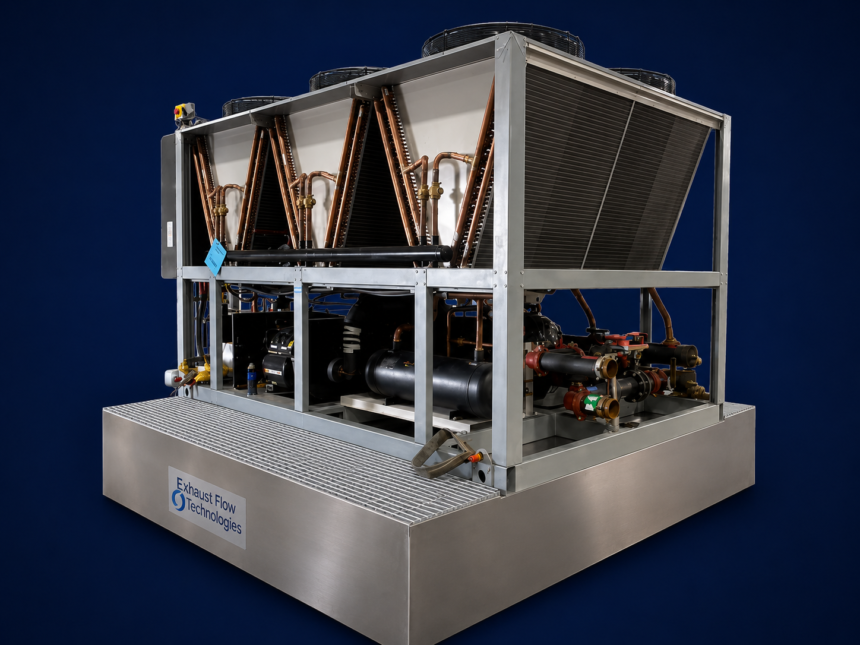
A press release that crossed my desk this week stopped me. ExhaustFlow Technologies, a Salem, NH-based airflow management company, has developed a patented integrated base system for air-cooled chillers and dry coolers that addresses the recirculation problem directly. Rather than compensating for hot air re-entrainment after the fact, the EFT system captures clean ambient air from outside the recirculation zone and displaces hot discharge air before it can be re-entrained. Independent CFD modeling shows up to 25% increase in cooling capacity and up to 30% improvement in plant efficiency, with zero water usage.
For an industry under pressure to do more with less, that combination is worth paying attention to. AI workloads are not getting lighter. Data centers need cooling solutions that solve problems at the source, not workarounds that add cost and complexity while the underlying physics remain unchanged.
The EFT approach won’t be the only answer to the data center cooling crisis. But it looks like one of the more elegant ones.