


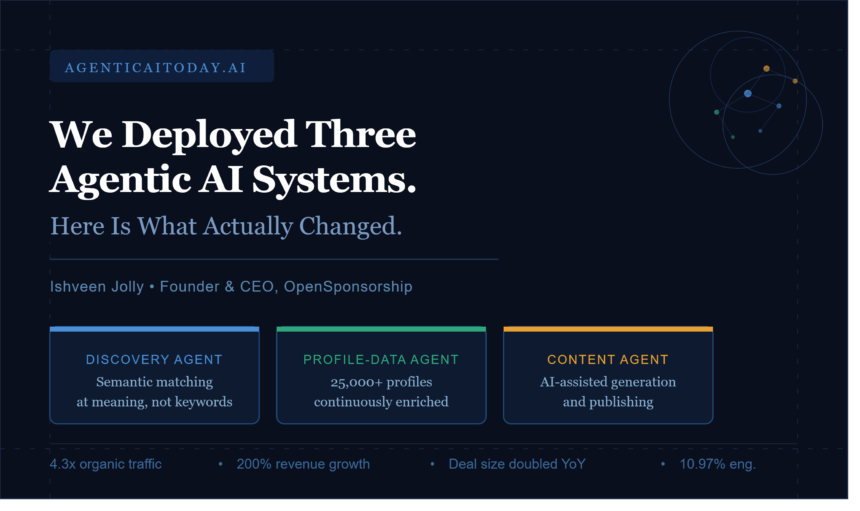
OpenSponsorship runs a platform connecting 25,000+ athletes and creators with brand partners across 160 sports and 120 countries. In Q2 2026 we put three proprietary AI agents into production. This is what we learned.
The Problem With Sponsorship Matching at Scale
An agentic AI marketplace has a matching problem that most platforms solve badly. A brand comes to us looking for a soccer player in the US with strong female audience affinity and a track record of health and wellness partnerships. The obvious tools search by sport, by follower count, by country. What they cannot do is read meaning.
Keyword matching finds athletes who have used the word “wellness” in a caption. Semantic matching finds athletes whose entire content pattern signals authenticity in that space, whether or not they ever used that word. Those are completely different outputs. The gap between them is where we saw the opportunity for agentic AI.
We have analyzed 14.9 million posts across our platform. Our data shows athletes on OpenSponsorship average a 10.97 percent engagement rate compared to 4.92 percent for traditional influencers. That delta does not happen by accident. It happens because the content is genuinely interesting, and because the match between athlete and brand is actually coherent. Getting that match right consistently, across 25,000 profiles, across 160 sports, is not a human-scale problem. It is an agent-scale problem.
Three Agents, Three Specific Jobs
We did not build a general AI layer and call it done. We identified three distinct operational problems and built a dedicated agent for each.
More Read

The Discovery Agent
This agent handles matching. It uses semantic embeddings built on top of social post data, so when a brand brief comes in, the agent reads for meaning rather than for keywords. A brief asking for “authentic outdoor lifestyle” does not need to match on those exact words. It needs to surface the athlete who posts about trail runs at 5am and tags their gear without being asked. The Discovery Agent finds that person. It finds them consistently and at a speed no human research team can match.
The Profile-Data Agent
Data decay is a real problem in athlete marketing. An athlete signs with a new team, their audience shifts. A creator pivots their content, their engagement profile changes. Static profiles become useless fast. The Profile-Data Agent runs continuously, automatically enriching and maintaining data across all 25,000+ profiles on the platform. Brands searching our platform are working with current information, not last quarter’s snapshot.
The Content Agent
Once a match is made and a deal is structured, content still needs to get created and published. The Content Agent handles AI-assisted generation and publishing workflows, reducing the time between deal close and live activation. Speed matters in sports marketing. A brand activating around a World Cup moment cannot wait three weeks for content to clear internal review. The agent compresses that timeline.
What the Numbers Showed
We are not claiming that three agents in production single-handedly drove our business results. But the correlation is real and worth stating plainly.
Organic traffic grew 4.3 times in Q2 2026, from 2,100 to 9,000 monthly visitors. The platform added 34 new ranking keywords. Average deal size doubled year over year, from approximately $2,500 in 2024 to $5,147 in 2025. Non-athlete creator deal volume grew seven times year over year. Revenue grew 200 percent in 2025.
The deals are getting bigger. The matches are getting better. The platform is reaching more people who actually need it. That is what good agentic infrastructure should produce: measurable improvement in the core business outcome, not just efficiency in a back-office process.
Where the Agents Stop and the Humans Start
This is the part of the agentic AI conversation that most founders skip over, and I think that is a mistake.
Our agents handle discovery, data maintenance, and content workflows. They do not negotiate deals. They do not advise a brand on whether a particular athlete is the right cultural fit for a product launch in a market they are entering for the first time. They do not read the room when a partnership conversation needs to pivot. Those decisions belong to people, and they always will.
The way I think about it: the agents clear the path. They surface the right options faster, keep the data clean, and compress the content timeline. Everything that requires judgment, relationship awareness, or contextual reading of a moment stays with the team. The agents make the human decisions better by removing the noise around them.
That division is not a temporary compromise while the technology matures. It is the right architecture for a marketplace business. Brands are trusting us with their reputation when they activate through OpenSponsorship. Athletes are trusting us with their name and their audience relationship. That level of trust requires human accountability at the moment of decision. Agentic AI earns its place in that chain by improving what humans can see and do, not by replacing the judgment call itself.
What Founders Considering Agentic AI Should Know
Three things we learned that I would tell any operator building agentic infrastructure into a marketplace:
Specificity is the whole game. A general AI layer is not an agent. An agent has a defined job, a defined success metric, and a defined handoff point. We did not build one AI system for everything. We built three agents for three distinct problems. That specificity is why they work.
Your proprietary data is the moat. The Discovery Agent is only as good as the 14.9 million posts it was built on. Anyone can access a foundation model. Not everyone has a decade of closed deal data, engagement benchmarks across 160 sports, and the ability to measure what actually converted. That data is the real competitive advantage. The agent is the mechanism that deploys it.
Measure the business outcome, not the AI output. We did not celebrate when the agents went live. We waited to see whether deals got better, whether traffic grew, whether brands came back. Those are the metrics that matter. If your agentic deployment cannot point to a business number that moved, it is a science project, not infrastructure.
Agentic AI is not a trend to get ahead of. For a platform operating at our scale, across the complexity of athlete marketing globally, it is the only way to do the job well. Three agents in production. Measurable results. Human judgment still at the center of every decision that matters.
That is the architecture we built. It works.
___
Ishveen Jolly is the Founder and CEO of OpenSponsorship, an AI-first athlete marketing platform connecting 25,000+ athletes and creators with brands across 160 sports and 120 countries. Named a Forbes 30 Under 30 honoree and SBJ Game Changer 2025, she has been featured in Sports Business Journal, the Daily Mail, The New York Observer, and Authority Magazine. opensponsorship.com